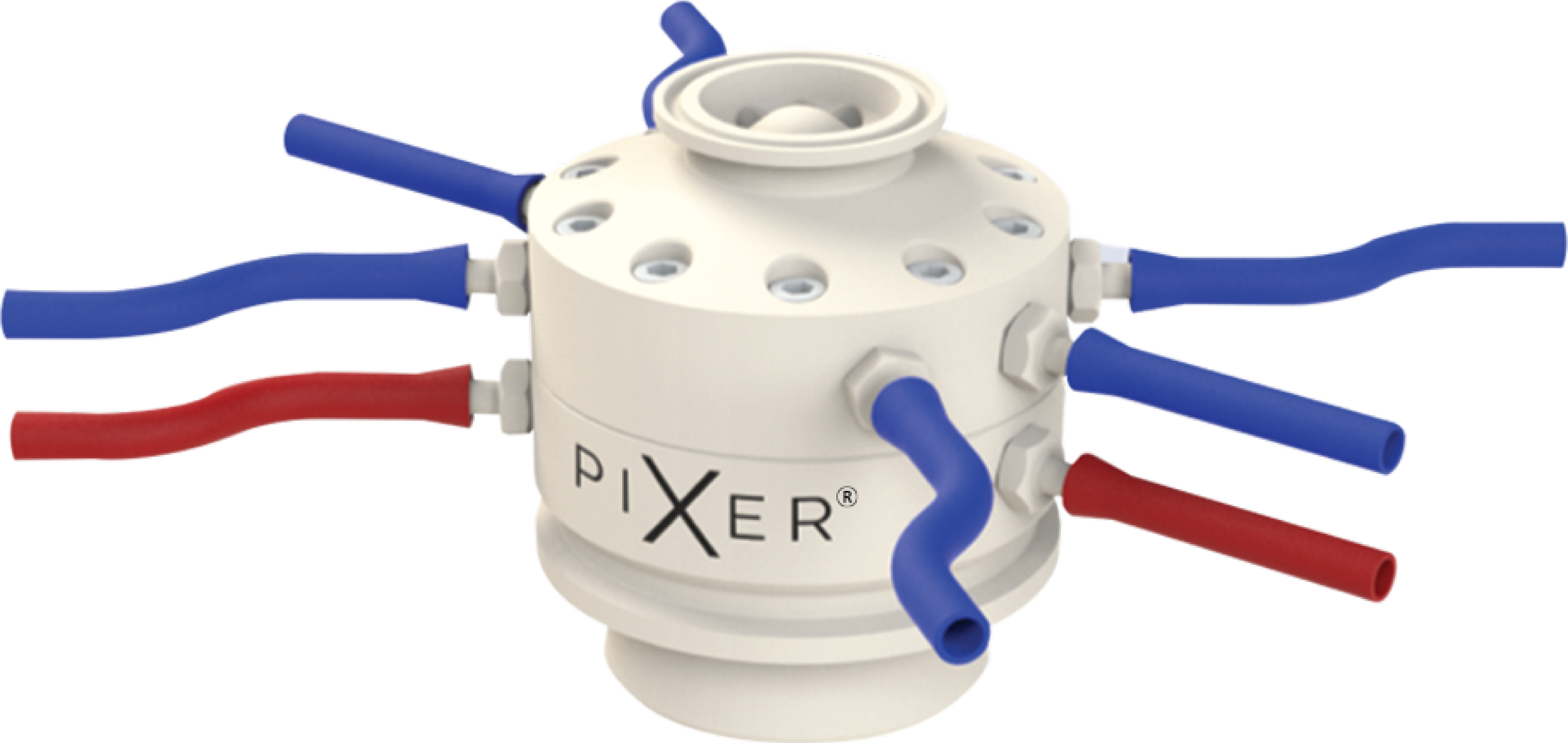
PIXER® Positive Displacement Diaphragm Pump
Precision Flow Control for Behavior-Critical Bioprocessing
PIXER® is a next-generation, single-use positive displacement diaphragm pump designed for bioprocesses where flow behavior directly impacts product quality, yield, and time to market.
Unlike legacy positive displacement pump technologies that prioritise throughput over behavior, PIXER® is engineered to deliver ultra-low shear, very low pulsation, and predictable flow behavior across a wide operating range — from early process development through GMP manufacturing.
PIXER® sits at the centre of Alphinity’s precision flow control philosophy, enabling stable automation, reliable handling of sensitive and high-value biologics, and scalable performance without repeated process redesign.
Why Flow Behavior Matters in Bioprocessing
In modern bioprocessing, pumps are no longer passive transfer devices. They are active control elements that influence process stability, product integrity, and automation performance.
Pump behavior affects:
Cell viability and product potency
Pressure stability across membranes and filters
Mixing efficiency and homogeneity
Closed-loop control performance
Validation effort and scale-up risk
Many traditional pump technologies introduce variability through shear, pulsation, or indirect control. That variability must later be managed through tuning, conservative operating limits, or manual intervention.
PIXER® addresses these challenges at the behavioral level, engineering variability out rather than compensating for it downstream.
Engineered to Eliminate Common Pump-Induced Failure Modes
Traditional pump architectures often struggle with air entrapment, inefficient priming, shear hotspots, pulsation, and pressure instability — particularly in behavior-critical processes.
PIXER® eliminates these issues at the architecture level.
A vertical, large-bore top inlet ensures gravity-flooded suction and instant, air-free priming.
A compact, five-diaphragm radial layout delivers smooth, low-shear flow with minimal pulsation and low hold-up volume.
Together, this architecture enables:
More flow at lower operating speeds
Greater efficiency under pressure
Stable, smooth flow across operating ranges
This allows PIXER® to perform reliably in shear-sensitive applications as well as viscous or high-concentration process streams, where pulsation and cavitation often drive fouling, instability, or product loss.
Performance That Scales With the Process
As illustrated in the performance data, PIXER® reaches target flow rates more quickly and delivers higher usable output under load compared to traditional multi-diaphragm pump designs.
This performance is achieved without increasing mechanical stress, enabling:
Stable operation at lower rotational speeds
Reduced cavitation and pressure shock events
More repeatable long-term process behavior
PIXER® maintains this behavior-first performance across its size range, supporting scale-up without sacrificing stability or requiring architectural redesign.
More Than a Pump: Integrated Mixing by Design
PIXER® is engineered to do more than move fluid.
It combines pumping and controlled inline mixing within a single platform, reducing reliance on external mixers and simplifying system architecture.
This allows PIXER® to simplify traditional mixing approaches by reducing reliance on external mixers or complex recirculation loops, while maintaining low pulsation, minimal mechanical stress, and predictable flow behavior.
Integrated mixing is particularly valuable in inline buffer dilution, feed blending, and continuous processing workflows.
Key Questions Explained
-
Flow behavior refers to how fluid is delivered over time — including smoothness, pulsation, pressure stability, and transient mechanical stress. PIXER® is designed to control these behavioral characteristics at the source, forming the foundation for stable processes and automation-ready systems.
-
Throughput alone does not determine bioprocess performance. Variability in flow behaviour can disrupt sensors, destabilise control loops, and increase validation effort. PIXER® focuses on predictable behavior to support repeatable, scalable processes.
-
Many losses attributed to “shear damage” are actually driven by pump-induced cavitation, pressure instability, and transient mechanical stress events. PIXER® minimises these damaging mechanisms through smooth displacement behavior and stable flow output.
👉 Read more in our blog: Is it shear damage or pump damage?
-
No. While PIXER® excels in shear-sensitive applications, it is also well suited for viscous fluids and high-concentration process streams where pulsation, cavitation, and pressure instability can cause fouling, performance drift, or product loss. PIXER®’s behavior-first design helps stabilise these processes as well.
-
Polymorphic Pump Technology® (PPT®) is a pump architecture that allows a single PIXER® pump to perform multiple process roles — such as transfer, recirculation, distribution, and mixing — while maintaining stable, predictable flow behaviour.
-
PIXER® delivers smooth, low-pulsation flow that stabilises pressure signals and sensor feedback. This improves closed-loop control performance, reduces tuning effort, and supports Pharma 4.0-aligned automation strategies.
How PIXER® Fits into Modern Bioprocessing
How PIXER Scales in Practice
PIXER® is designed to maintain consistent flow behavior across pump sizes, not simply increase flow capacity.
As processes scale from development to GMP manufacturing, traditional pumps often require re-tuning, architectural changes, or conservative operating limits to manage pulsation, cavitation, and mechanical stress.
PIXER® preserves the same behavior-first design philosophy across the P0–P40 range, allowing teams to scale flow while maintaining predictable performance, stable automation, and consistent process dynamics.
Detailed performance curves, configurations, and materials data are available in the PIXER® datasheets.
Who PIXER Is Designed For
PIXER® is designed for teams building processes where flow behavior directly affects outcomes.
It is particularly well suited for:
Shear- and cavitation-sensitive biologics
Viscous or high-concentration process streams
Pressure-sensitive unit operations such as filtration and TFF
Automated or semi-automated processes
Platforms expected to scale without repeated redesign
Where stability, predictability, and product protection matter more than brute-force throughput, PIXER® provides a more reliable foundation.
From Pump to Platform
PIXER® is not designed as a standalone pump, but as a foundational component within Alphinity’s single-use process systems.
PIXER® is integrated across platforms including inline buffer dilution, viral inactivation feed systems, and benchtop and scalable TFF architectures.
When combined with ConSynSys automation, PIXER® supports:
Centralised control architectures
Stable sensor feedback and closed-loop control
Predictable, repeatable process behavior
Together, they enable future-ready, behavior-driven manufacturing strategies aligned with Pharma 4.0 and quality by design principles.
Bioprocessing Pump Data Sheets
Frequently Asked Questions
-
PIXER™ is a single-use, positive displacement diaphragm pump platform engineered for behaviour-critical bioprocessing.
Built on Polymorphic Pump Technology®, PIXER™ delivers stable, low-shear flow with minimal hold-up volume across a wide operating range — from process development through GMP manufacturing. -
Unlike legacy diaphragm, piston, or peristaltic pumps, PIXER™ is designed around flow behavior, not just throughput.
Its vertical top-inlet architecture, multi-diaphragm radial design, and controlled actuation deliver:
Ultra-low shear and reduced cavitation risk
Very low pulsation
Predictable flow under load
Faster air-free priming and full drainability
PIXER™ also combines pumping and inline mixing in a single platform, reducing system complexity.
-
PIXER™ supports flow rates ranging from single-digit mL/min to over 200 L/min, depending on configuration.
This enables a single pump platform to support applications from early development through commercial manufacturing. -
PIXER™ is designed for new systems or bespoke integrations, rather than as a direct retrofit into legacy skids.
Alphinity works with customers to design custom integration strategies that upgrade system capability while preserving downstream compatibility.
-
PIXER™ is constructed using materials selected for chemical compatibility, durability, and long-term single-use performance, including:
Polypropylene (PP) pump body
TPV diaphragm materials
Elastomer seals optimised for bioprocessing
This combination resists swelling or fusing during extended operation and long-term closures.
-
PIXER™ is designed for use in regulated biopharmaceutical environments and meets key industry expectations, including:
FDA compliance
USP Class VI biocompatibility for wetted components
BSE/TSE free materials
Manufactured in ISO Class 7 cleanroom conditions
-
Yes. PIXER™ is designed to support automation-ready and data-driven manufacturing.
It is compatible with closed-loop control strategies for flow and pressure and aligns with modern SCADA, MES, and advanced analytics platforms — including integration with ConSynSys automation architectures.
-
PIXER™ is particularly well suited for processes where flow behavior directly impacts outcomes, including:
Cell and gene therapy (CGT)
mRNA and lipid nanoparticle (LNP) processing
Viral vector and vaccine manufacturing
Biosimilars and high-value biologics
Continuous and hybrid manufacturing workflows
-
PIXER™ helps teams achieve:
Improved product recovery through low hold-up design
Gentler handling of shear- and cavitation-sensitive biologics
Reduced system complexity by combining pumping and mixing
Stable automation and control performance
Faster changeovers with single-use operation
-
By eliminating cleaning-in-place cycles and reducing system complexity, PIXER™ can deliver:
Significant reductions in water, energy, and chemical use
Lower operational downtime between batches
Reduced waste through improved recovery and fewer process failures
These gains translate into lower cost-of-goods and improved ESG performance.
-
PIXER™ is designed for:
Biopharma manufacturers scaling from PD to GMP
CDMOs seeking stable, automation-ready flow control
CGT and advanced therapy developers protecting fragile products
Engineering teams reducing validation and re-engineering burden