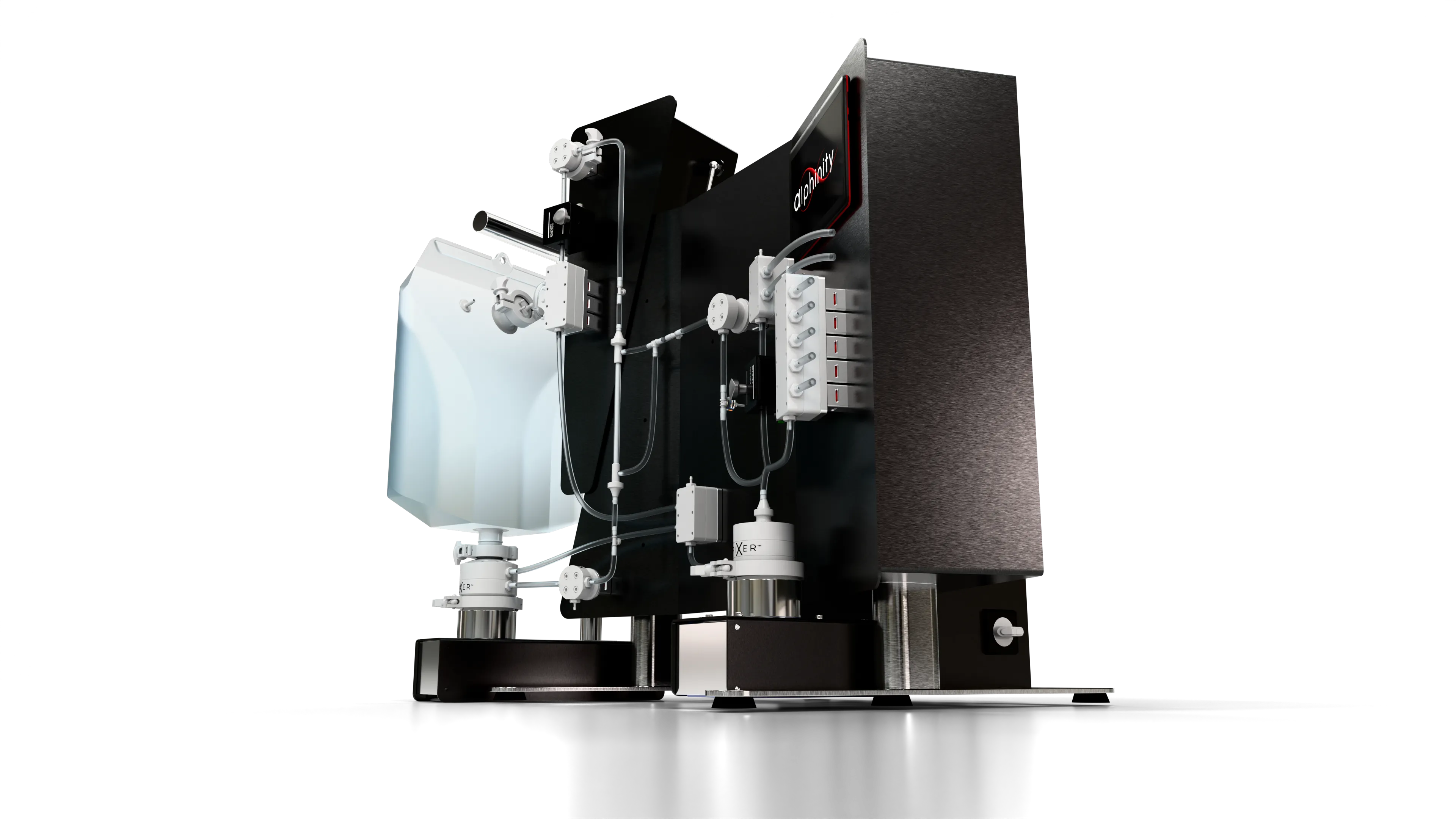
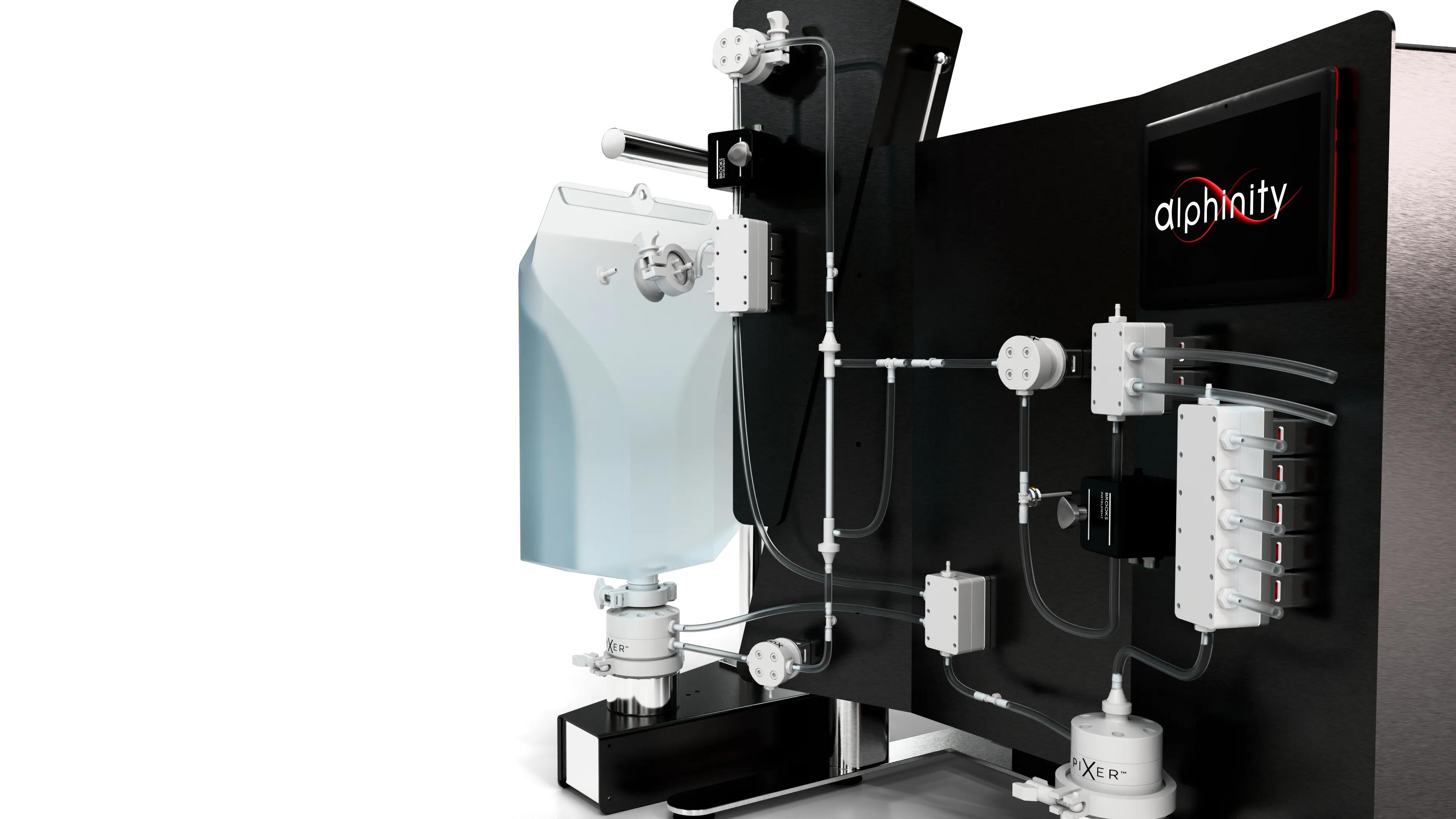
Bespoke Bioprocessing Systems

Built Around Your Process

Engineer-to-order systems powered by precision flow control — from development through GMP.

Alphinity designs bespoke bioprocessing systems for manufacturers facing flow, pressure, and integration challenges that standard equipment cannot solve.

We build engineer-to-order (ETO) systems using next-generation single-use components, automation, and precision flow control — enabling fragile, viscous, pressure-sensitive, and process-intensified operations to become manufacturable at scale.

We don’t start with a skid.
We start with your process.

Why Standard Bioprocessing Systems Fall Short

As bioprocesses evolve, many manufacturing challenges are no longer chemical — they are physical and mechanical.

Across the industry, teams increasingly face:

  • Fragile or shear- and cavitation-sensitive modalities

  • Viscous or non-Newtonian fluids

  • Pressure-sensitive membranes and filtration steps

  • Process intensification and continuous workflows

  • Automation instability driven by flow variability

Standard, catalogue-based systems often force processes to adapt to equipment — leading to workarounds, conservative operating limits, repeated redesign, and delayed scale-up.

Alphinity exists to close this manufacturability gap by engineering systems where flow behavior, pressure stability, and scalability are designed in from the outset.

What Makes Alphinity Different

Our Engineer-to-Order Process

Every Alphinity system follows a structured, qualification-aligned process:

  • Concept Design — defining process behavior, risks, and scale intent

  • Detailed Design — engineering architecture around the process

  • Build — system assembly and integration

  • Install, Test & Commission — IQ/OQ-ready execution

  • Support & Service — lifecycle partnership beyond handover

This approach ensures systems are manufacturable, automatable, and scalable — not just functional on day one.

A promotional graphic titled 'What Makes Alphinity Different' listing five features: process-led, smart modularity, precision built-in, future-ready, and partnership beyond delivery, each with a respective icon and description on a black background.
A project milestone timeline with five stages: Concept Design with a red marker, Detailed Design with a blue marker, Build with an orange marker, Install Test & Commission with a green marker, and Support & Service with a purple marker.

What We Build

  • Stainless steel laboratory or industrial equipment with electronic controls and tubing.

    Plexus Process System

    The PPS is a multi-process system enabling multiple unit operations

  • A scientific experimental setup with various machines, including a control panel, a monitor, and interconnected glass tubes, used for chemical or biological experiments.

    Viral Inactivation and Filtration

    Superior mixing with exception low flow performance

  • Automated industrial filling machine with multiple transparent containers and a computer interface, used for filling liquids.

    Buffer Dilution

    Accurate, repeatable buffer preparation using controlled inline mixing

Engineering the Hard Problems in Bioprocessing

Alphinity’s systems are designed in response to fundamental challenges shaping modern bioprocessing — challenges that are physical, mechanical, and architectural, not just biological.

  • Many next-generation therapies are scientifically viable but physically difficult to manufacture. Mechanical stress, pressure variability, and unstable flow behaviour increasingly limit scale-up. Alphinity designs systems that address these physical constraints directly — enabling fragile modalities to transition from PD to GMP with greater confidence.

  • Product damage is often blamed on shear, but cavitation, pressure transients, and unstable flow are frequently the real drivers of yield loss. Alphinity systems are engineered to eliminate these hidden failure modes at the architecture level, protecting product integrity and improving batch consistency.

  • Scale-up often fails when mechanical realities change between development and manufacturing. Alphinity preserves physical process conditions — flow behaviour, pressure profiles, and stress — across scales to reduce re-engineering and validation risk.

  • Yield loss, reprocessing, and batch failure significantly increase waste and energy use. By engineering out mechanical stress and instability, Alphinity helps manufacturers reduce waste at the source — turning process robustness into a measurable sustainability lever.

Let’s Build What Your Process Actually Needs

From early development through GMP manufacturing, Alphinity designs systems that restore control where standard equipment breaks down.